
This article was written by Lawrence Larcombe and was originally published by Oxhey Village Environment Group in December 1996. At the time of writing his article, Lawrence was living at 24 Upper Paddock Road in Oxhey Village. His words remain unedited.
Footnotes with additional information are available after Lawrence’s article.
I was born in Northwood in 1913, but moved to Harrow soon after – where we lived through the years of the First World War. I have a good memory and can remember running for shelter from an air-raid in Harrow in 1916 or 1917. My father did a milk round in Harrow – with a barrow – but because he was a Watford man, we moved to Oxhey (or New Bushey, as it was then called) in September 1918 moving into 26 Upper Paddock Road.
Paddock Road area had been a large orchard and was split up into building plots. Our house was on one of these plots and we had another two plots as garden. These plots were originally sold by auction on 19 October 1861 when they were described simply as Paddock Road – no Upper. A document dated 17 June 1892 refers to the road as South Paddock Road. On 5 May 1915 it became Upper Paddock Road, Parish of Bushey. The first document showing it as Upper Paddock Road, Oxhey is dated 15 February 1929.
Having been originally an orchard, the house that we came to – No. 26 – had a large garden, with over 30 fruit trees – apples, pears, plums, cherries, and many soft fruit bushes. At the bottom of the garden there was an old pigsty, which we used as a chicken house, and beside it was a large area of horseradish where the hens used to lay their eggs in – rather than using their nest boxes.
At the other end of the garden was a large brick building, which contained a copper, a fireplace, and something that looked like a baker’s oven. We used this building as a coal shed, a cycle store and, on bath nights, a spacious bathroom. The building suddenly collapsed one evening, leaving my father’s cycle a ‘funny’ shape. Fortunately, no-one was having a bath at the time as there could have been serious consequences. The chicken house also fell down and the remains of both buildings were made into very pretty rookeries.
We shared the garden with many animals – ducks, rabbits, bantams, pigeons and Rosie, a Shetland pony.
In 1919, I started at Oxhey School. This was a mixed school but boys were transferred to London Road School at the age of seven. I had not started school till I was six because of illness, and then I contracted Scarlet Fever, which in those days was a serious complaint, so I was away for three months, resulting in a very short time there.
In 1920, I went to London Road School and stayed there until the week I reached my 14th birthday, but I learnt enough there to enable me to work for the same employer for 47 years.
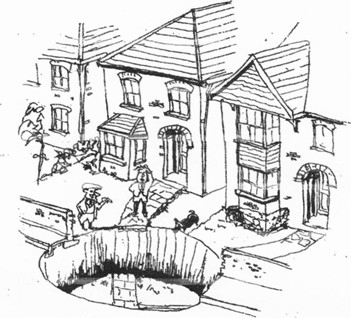
While I was still at school, I did a paper round for Mr. Longhurst of the paper shop in Capel Road (now a hairdresser). It was a widespread round: Eastbury Road, Kingsfield Road, Oxhey Road and as far as Hampermill Lane. One day, when I was doing my round, the ‘Great Hole of Oxhey’ appeared in Kingsfield Road. Although the road was closed, I was allowed to go through to deliver the papers. Part of Kingsfield Road and the front gardens of two of houses had disappeared into a hole 70 feet below. This was June 1927.
While attending London Road School, Attenborough’s Fields made a pleasant short cut during the summer months. We went across the old brickfield, now Oxhey Green, then through the fence, over the grass to the Haydon Road gate, and up the hill to the rear gate of the school. As Mrs. Rutherford mentioned in her History No. 7, people were supposed to keep to the footpaths, but we boys didn’t always obey the rules and were often chased by the Park Keeper.
The fields were also a favourite place to play in the evenings and sometimes Mr. Attenborough would hear us and come out himself. But it was easy for us to dodge him as he was a gentleman with very poor eyesight. I can remember seeing Mr. Attenborough being driven to Bushey Station each morning in his own horse-drawn carriage and being picked up from there in the evening.
Many Oxhey people will remember Vale’s Stores on Chalk Hill, but how many know that that shop was built in 1889 and that previously Mr. Reynolds Vale came from Somerset opening a grocers shop at 88 Villiers Road in 1881! This, of course, is now the fish and chip shop. I still live in Upper Paddock Road. My present house was built in 1962/63, on the two spare plots of No. 26 and I have lived in this road longer than any of the other residents!
Further information
The Great Hole of Oxhey
In his article, Lawrence refers to the ‘Great Hole of Oxhey’. This refers to a large sinkhole that appeared outside 63 Kingsfield Road, in Oxhey Village in June 1927. The event is sometimes referred to as the ‘Oxhey mystery chasm.’ Videos of the sink hole are available from British Pathé:
– Oxhey mystery chasm (long version)
– Oxhey mystery chasm (short version)
Villiers Road fish and chip shop
The fish and chip shop that existed at the time of Lawrence’s article is now the Alexander Express Lebanese takeaway at 88 Villiers Road.
Vale’s Stores
Lawrence refers to Vale’s Stores on Chalk Hill. The original property at 35 Chalk Hill was long since demolished, but a newer building – in roughly the same shape – was constructed in around 2021. It now houses a dry cleaners and a hairdressing training school. You can read a Watford Observer article, by Lesley Dunlop which includes more information about Vale’s Stores.

You must be logged in to post a comment.