
This article was written by Ian Davis and was originally published in the Oxhey Village Environment Group autumn 2025 newsletter. His words remain unedited.
If you have additional information on the subjects covered in this article, please contact history@oveg.org.
Many people know that OVEG grew out of a local campaign to prevent Attenborough Fields from becoming a golf course, but how many know that in the 1970’s there was a serious proposal to build a motorway right across Merry Hill?
The story begins post-World War 2 when planning authorities such as the Greater London Council predicted the rise of the motorcar, and a decline in public transport use. They seriously considered a series of four motorways, known as “the Ringways”, circling London with more motorways leading out of London to join them.
At that time, planning for road traffic was no more sophisticated than “predict and provide” (in other words guessing how much traffic was likely in 10 years’ time and how many new/widened roads would be needed to cater for it). There was also a powerful road lobby actively undermining public transport and advocating for motorways. Indeed, the infamous Dr Beeching (who happened to be chairman of Marples Ridgway, the road construction business) was enabled by the Minister of Transport, Ernest Marples, to build the Hammersmith Flyover and other concrete delights.
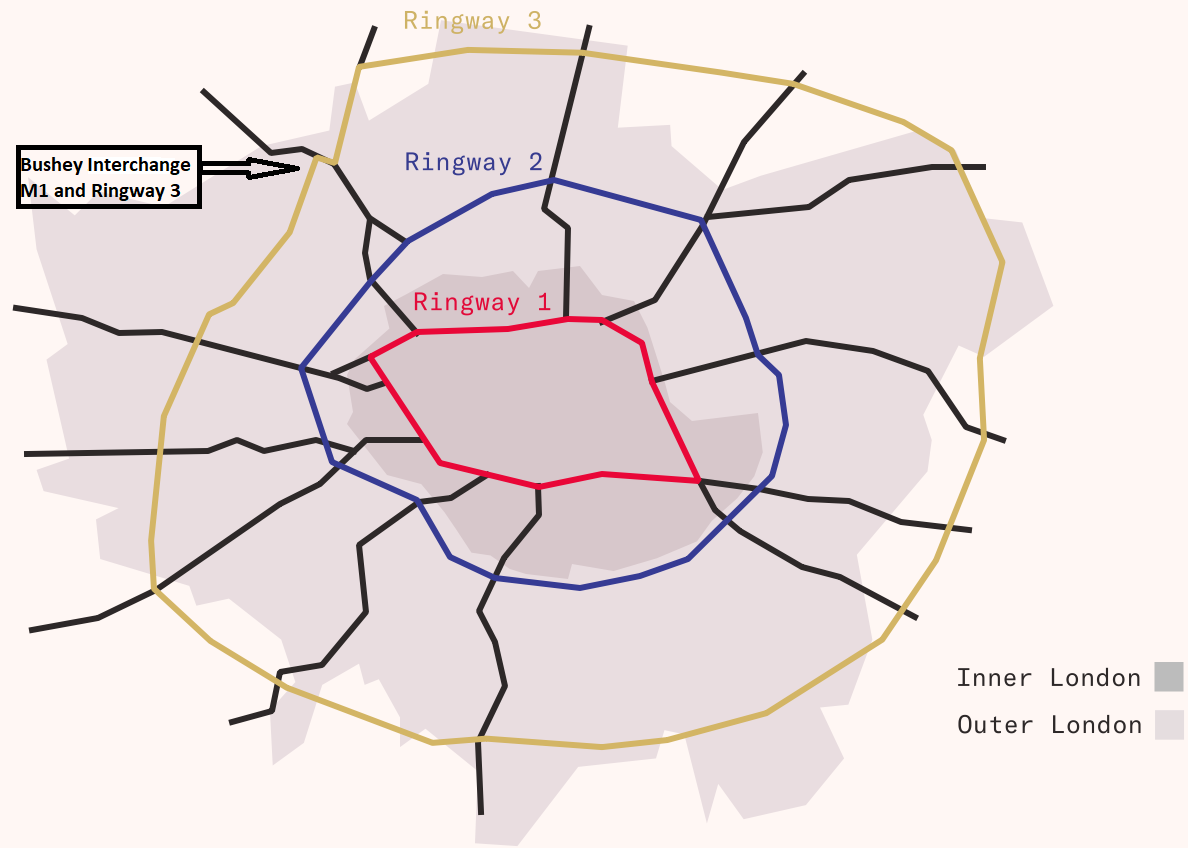
So why were they never built? Not surprisingly the Ringways 1 and 2 were the most controversial. Ringway 1 sliced through places such as Camden and Islington, and Ringway 2 was partly built as the North Circular (a near-motorway). In practical terms, the cost of construction would have been astronomical, and hundreds of houses would also have needed to be demolished, so they were abandoned.
Interestingly, the one that would have affected us in Watford (Ringway 3) had far less opposition during the 1960’s and early 70’s, because many outer-London boroughs and county councils were experiencing an increase in heavy goods vehicles on narrow A-roads (as freight on the railways diminished) and favoured the idea of lorries being accommodated on new, wider roads.
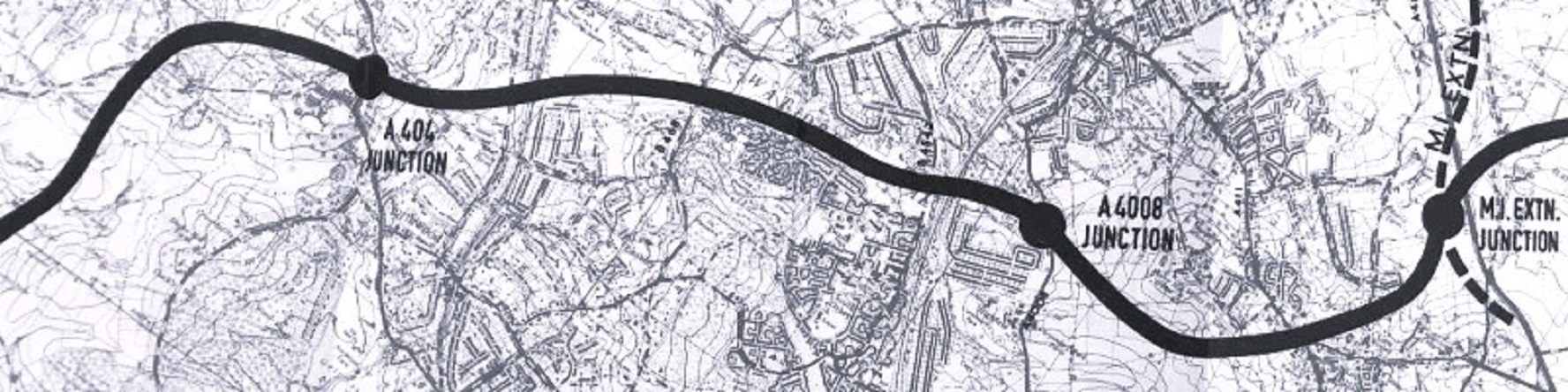
Travelling from east to west there would have been a junction with the M1 and A41 called the Bushey Interchange. It then headed further west through the centre of Bushey Heath and across Merry Hill before meeting the A4008 Pinner Road via a huge junction which would have become the main access for Watford. It continued westward through Carpenders Park Lawn Cemetery and just south of Hillcroft
Crescent in Oxhey Grange, before crossing the Eastbury Road and finally cutting across Moor Park to a further junction by Mount Vernon Hospital.
Now, in the 2020’s, it seems remarkable that such a massive scheme could ever have been contemplated. Arguably, it was the Ringways proposal that led to anti-road and pro-environmental lobbying following the construction of the Westway. (This led to a lot of anti-motorway sentiment due to the sheer cost and destruction of homes and green belt land.) We now know that building a major road simply creates “induced demand”; in other words, if you build a new road then increasing numbers of cars use it until, over time, the road clogs up. Demand for public transport falls initially as driving is easier but then rises again (by which time buses or trains have often disappeared).
In the end, only a single orbital motorway (the M25) was built. This is a blend of Ringways 3 and 4 which is why, in some parts, it takes some odd turns where infill sections were built to link the semi-completed sections.
You must be logged in to post a comment.