
This article was written by Tony Bliss and was originally published by Oxhey Village Environment Group in November 1999. His words remain unedited.
Footnotes with additional information are available after Tony’s article. If you have additional information on the subjects covered in this article, please contact history@oveg.org.
I was only three months old when I moved to Grover Road, that was December 1938, therefore my earliest memories were of wartime.
The houses in Grover Road were mostly built in 1888 and consisted of long, terraced blocks originally build as three bedroom dwellings with no bathroom, a central staircase and a stone ‘copper’ in the downstairs room at the back which we called the ‘scullery’. Built on the back outside was a coal store and a toilet. A shed was added on the back which housed a cast iron mangle for those Monday wash-days. The living room at the rear was known as the ‘kitchen’ which had a fitted cast iron grate and oven for cooking. This had to be cleaned regularly with a black lead liquid called ‘Zebo’. The chim-ney sweep would call twice a year and one of my tasks was to stand at the bottom of the garden and check to see if the brush did in fact appear out of the top of the chimney.
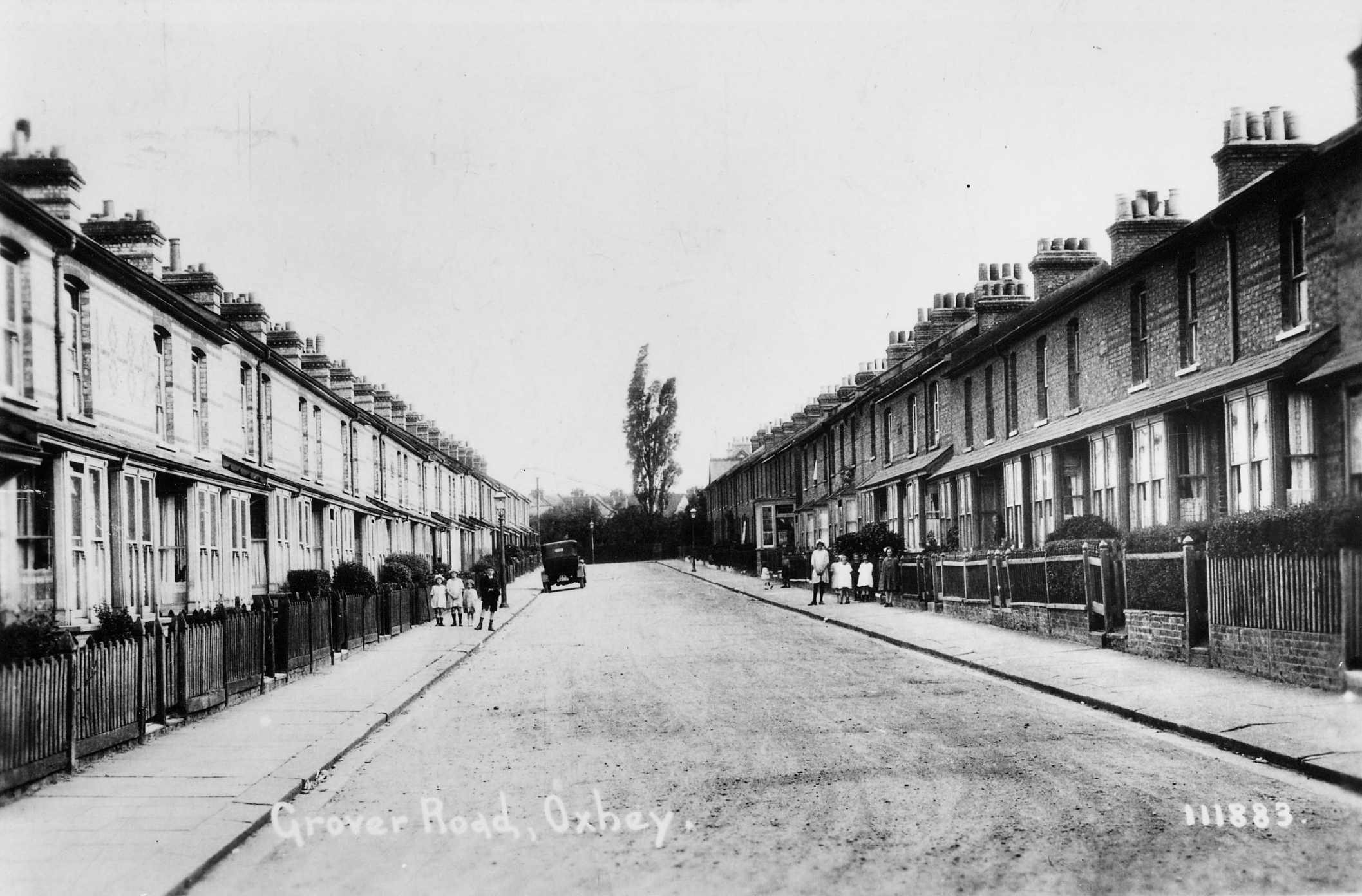
I must have been three or four when men arrived in the road to cut down all the iron railings with oxyacetylene torches to be taken away as scrap metal for the War effort. Anderson shelters with corrugated iron roofs were installed in the rear gardens, although most people used them for storage purposes.
Although a few bombs had dropped near Bushey station earlier in the War, the occasion I can remember was when a breakfast-time doodlebug fell in Oxhey Lane. The blast smashing windows of many houses in the road.
At the time just after the War, many houses were rented from private landlords who were reluctant to carry out repairs and improvements. However, my father was a builder and the stone copper and grate had now been removed.
When peace was finally declared street parties erupted all over the country. In Grover Road a piano was wheeled into the street for singing and dancing. It was played by Mr. Jack Bean from neighbouring Oxhey Street. This was followed by a more organised party in the parish hall in Pinner Road. Of course, at the time many fathers, sons and daughters of these largely working class families were still away in the armed services.
For the next few years families were forced to live under strict food rationing conditions. However, to supplement this, fruit and vegetables were grown on a substantial allotment plot at the rear of the houses nearest the railway, although the soil was poor compared with Paddock Road allotments.
For the children during the period after the war years my greatest memories were the cine film cartoon shows held at a big old detached house called The Firs at the top of the road. The shows were hosted by the owner Mr. Stan Poplet. We sat on wooden forms in the lounge and were served large orange drinks by Stan and his sister Queenie during the interval. Mr. Poplet also organised a summer outing for the children using Kirbys coaches from Bushey for trips to Whipsnade and Chessington Zoo where he would pay for tea in the restaurant for every child. Not many tradesmen called at Grover Road.
There was, of course, the milkman, the coal man and the baker. Also the knife and scissor sharpener. His tools and equipment were all arranged on a pedal cycle. A stand lifted the rear wheel off the ground which enabled him to pedal through chain and belts to drive his grindstone. The corner comer shop with Pinner Road was a confectioner and tobacconist run by a tall pipe smoking Scotsman called Mr. Bisset who made a habit of throwing sweets in the scales!
My most unforgettable character whom I worked for was Dick Longhurst who had the paper shop in Capel Road. Dick was a popular man, short and stout with a ruddy complexion and always seen wearing a brown smock coat and flat cap, always pushing his delivery bike loaded with newspapers.
When I arrived at his shop after school my ‘bonus’ was usually a bottle of drink. On a Saturday, especially when Watford were playing at home, a crowd of young men would congregate in the shop to talk about football. When 14 new houses were built in Lime Close, Dick gave me 2/6d (121/2p) for every new customer I secured. Another tradesman eagerly awaited was the log man around November time. This was Mr. Flanagan, the owner of Flanagans Fun Fair based in Oxhey Lane who sold cut logs by the sackful from the back of a large truck.
Outwardly little has changed, except nowadays modernisation and private ownership and, of course, the motor car.
Further information
This article was previously known as OVEG History Sheet 19.
Lime Close
Tony refers to the construction of Lime Close, which lies less than 100m from the southern end of Grover Road. As detailed in Keith Julier’s article on the history of Oxhey Avenue, Lime Close is was build on the site of the former Lime Lodge; a two-storey white home with a spacious studio. The property was home to a Mary Bromet (nee Pownall), a Lancashire-born sculptor who went on to become president of the Society of Women Artists. From 1903 to 1931, Mary lived there with her husband Alfred Bromet. Bromet School is named in her honour.
You must be logged in to post a comment.