
This article is a description of the Watford Heath School Kitchen. It is an extract from the first part of an Open University dissertation by Audrey Adams. The article was provided to Oxhey Village Environment Group by Brian Hutt and originally published by OVEG in a 1994 newsletter.
The Watford Heath School was an elementary school, originally built in the 1850s, and reopened in 1873 as a Church of England school for around 60 pupils. The originator of the school was the Reverend Newton Price, the Chaplain of Oxhey Chapel, who became the first Vicar of Oxhey when the new parish Church of St Matthews was consecrated in 1880.
Newton Price persuaded the managers of the Watford Heath School to introduce cookery into the curriculum, and in 1875 a purpose built kitchen block was erected in the school playground. Documents related to the kitchen initiative, were eventually given to Watford Library, and include the ‘Kitchen Journals’ giving an idea of the meals and the expenditure on them.
Footnotes with additional information are available after Audrey’s article. If you have additional information on the subjects covered in this article, please contact history@oveg.org.
Introduction
A cluster of five small brick-built cottages stands behind the bus stop on Watford Heath. These cottages were once an elementary school, built in the 1850s to serve the hamlet of Watford Heath, which is situated south of Watford on the main road to Harrow and Pinner. This elementary school is of particular interest because it was among the first – possibly the first – to introduce the teaching of cookery.
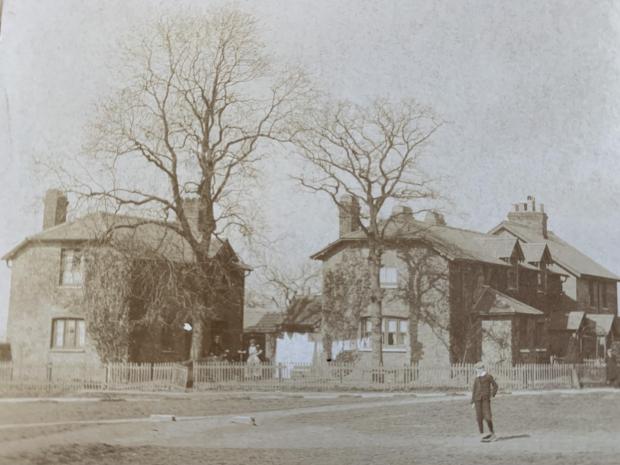
The early history of the Watford Heath School is unclear. It was built in the 1850s – the original architectural drawings, dated 1854, still exist – but was closed in about 1860. In 1873, the school was reopened as a Church of England mixed elementary school for about 60 pupils on the initiative of the Reverend Newton Price (Beal, 1968).
Newton Price (1834-1907) was chaplain of Oxhey Chapel and became the first vicar of Oxhey when the new parish church of St Matthews was consecrated in 1880. He had been headmaster of Dundalk grammar school before his ordination and took a keen interest in education (Watford Observer, 1907). He persuaded the managers of the Watford Heath school to introduce cookery to the school curriculum, and in 1875 a purpose-built kitchen block was erected in the school playground. The building cost £100, which was donated by Mr William Eley of Oxhey Grange, the local landowner. It was designed by W.H. Syme, a Watford architect, in a “plain, brick-built style” (Price, 1877), and fitted out to resemble a cottage kitchen.
Price retained many documents relating to the Kitchen, and on his death in 1907 they were given to Watford Library. This was especially appropriate as the Library was another of Newton Price’s consuming interests during his lifetime. (Watford Observer, 1907).
The Kitchen Journals, covering the years 1875-81, are of particular interest. These are basically account books giving a detailed breakdown of the expenditure on every meal cooked in the Kitchen. But they also list the menu cooked, the names and duties of the pupils involved and handwritten notes and recipes. There seems no reason to doubt the authenticity, date or provenance of the Journals, and they are of particular value in describing the day-to-day activities of the Kitchen. However, the accounts should perhaps be regarded with slight suspicion: they were completed by the teacher in charge of cookery, who owed her livelihood to the maintenance of the classes and may have considered it politic to paint a rosy picture of the School’s finances.
Watford Heath School, kitchen
The kitchen was opened with a demonstration lesson from Mr Buckmaster, a lecturer at the Kensington School of Cookery (a national training centre for prospective elementary school teachers). A month later, on 20th April 1875, he made a successful return visit. Cookery lessons were held twice a week, on consecutive days for maximum economy. The classes were conducted by pupil teachers who had attended an eight-week course in practical artisan cookery at Kensington. A maximum of six girls did the cooking, and two or three younger girls were on hand to assist and clear up. Right from the beginning, the emphasis was on practical experience, with each girl being allotted a specific task in the preparation of an “ordinary dinner” (Price, 1877). This was an innovation of great importance, and one that was to set Newton Price on a collision course with the Schools Inspectorate. Although the subject of Domestic Economy had been included in the Educational Code since 1874, the limited time allotted to this subject (40 hours per year) persuaded most schools to teach cookery through demonstration, if at all. (Hurt, 1979).
The meals were plain, simple and nutritious: for example, Boiled Bacon, A-La-Mode Beef, Toad in the Hole or Mutton Broth, all served with plenty of vegetables, and a pudding – perhaps rice, treacle or apple – to follow. A particular favourite was sheep head served with rice: a hand-written recipe appears in the journals opposite the entry for 25th May 1875. It is difficult to imagine a modem 12-year-old (or indeed anyone older) tackling a recipe which began:
“Clean the head well, and let it soak in warm water to draw out the blood…..”, and ended: “….The brains should be boiled, then chopped very fine, and laid on the head, here and there, in small lumps”.
This dish became so popular among local residents that Newton Price later complained that the price of sheep heads had become “abnormally dear in the neighbourhood” – up from ninepence each to one-and-tuppence. (Price, 1887)
The children were charged 2d each for their dinner, while the teacher was paid one shilling per lesson – though -if the meal cost more than 3d per head, the excess was deducted from her salary. This happened rarely. Newton Price insisted on detailed accounts to instil “method and regularity and to assist supervision by the school managers” (Price, 1877). The 1876 accounts showed a total loss of over £15, as follows:
1. Loss on food (784 rations) 2. 16. 3
2. Coals 1. 0. 0
3. Fee to Kensington Training School 3. 3. 0
4. Teachers’ Fees 5. 5. 0
5. Receipts and printing 17. 0
6. Aprons etc 16. 5
7. Extra furniture 3. 10. 11
15. 9. 4
The cost of running the school kitchen was a controversial subject, and Newton Price was well practised at justifying and defending the expenses incurred. In reviewing these accounts, Newton Price pointed out that items 3 and 7 were optional, non-recurring payments, while he dismissed the loss on food as “trifling”. In-deed, he argued that the kitchen could become self-supporting if the dinner charge were raised to 3d – a price at which he was sure there would still be plenty of customers. (Price, 1877)
Newton Price involved the School Kitchen in catering for local groups involved in “improving” activities including the Oxhey and New Bushey Recreation Society, the Choir and the Workmen’s Club. The older girls in standard VI – aged 13 or so – had the opportunity to cook a “trial dinner” unaided: if they passed this test, they were permitted to assist in the preparation of occasional suppers for local organisations, for which they were paid. These suppers were a useful way of giving the girls extra practice without cost to the kitchen (Price, 1877) . “The Times” of 1877 contained an anonymous account of a supper prepared for 50 members of the local Youth’s Guild:
“The supper was to be held in the village school-room, and was announced for half past seven. There were five or six little waiters, children from the school who had helped to cook the supper in the large kitchen situated a few feet only from the school-room, who averaged about fourteen years of age, ready to do their work, and right well they did it under the superintendence of a most willing school mistress. The repast began with haricot and milk soup. Both of them were excellent, but the haricot soup was most appreciated by the company …Method, regularity, cleanliness, and economy are the watchwords of the kitchen. …Here was a most excellent supper – nourishing, well-cooked, palatable – and only costing, it seems almost incredible, about 9d a head.”
Newton Price was a passionate defender of the School kitchen and gives the impression throughout his writings that it was a project particularly close to his heart.
But why did he consider the teaching of cookery at elementary level to be so important?

In 1887, he told the Cross Commission on Education that his interest had been aroused after seeing “the wretchedness of so many homes from the want of knowledge on the part of the head of the home, the mother.”
He continued: “The principle is not to train cooks for rich men’s houses, but managers for poor men’s homes to teach them economy, ingenuity and cleanliness”.
He told the Congress on Domestic Education in 1877 that “It is based on a desire to spread contentment and domestic comfort, to cheer the lives and purify the tastes of those who spend day after day in a dreary round of monotonous labour.
“It is an economy and temperance movement”.
These statements suggest that Newton Price regarded the teaching of cookery to schoolchildren as a contribution to the crusade to civilise the working classes, and in particular to protect them from the evils of drink.
Cookery had an undeniably lower profile than some of the other Victorian campaigns to redeem the lower orders – for ex-ample the Temperance movement or the Salvation Array. But Price was by no means alone.
At the Congress on Domestic Economy held in Birmingham in 1877 and again in 1878, speaker after speaker endorsed his views, some with an almost messianic fervour.
It might be thought that this wave of middle class concern would lead to the establishment of a whole network of cookery schools, but this was not the case.
Not everyone was convinced of the value of teaching cookery, and some of the opposition came from an unlikely quarter.
The Education Department raised all sorts of practical objections, including the lack of facilities and specialist teachers, and the expense.
This in itself was surprising: as early as 1832, Sir James Kay-Shuttleworth, then Secretary of the Education Department, had complained that “Domestic economy is neglected, domestic comforts are too frequently unknown”.
By 1877, Sir Henry Cole, one of Kay-Shuttleworth’s successors, was still lamenting the fact that domestic economy for girls was rated only tenth in the Educational Code – behind such comparatively obscure subjects as mechanics and botany.
Although the inclusion of domestic economy in the Educational Code meant that grants were available the limitation on hours and the lack of facilities militated against practical cookery.
Newton Price had managed to solve most of the practical difficulties at Watford Heath, but he still endured a running battle with the School Inspector, who threatened to suspend grants to the school.
In his writings, Newton Price comes across as essentially moderate and sensible: however, in describing the visit of the School Inspector, he is positively splenetic: “Nothing that could be done by him was left undone.
“Our timetable was rejected, we were told our grant was in danger… Had the proposal been to teach Syriac (the ancient Semitic language of Syria), the opposition would possibly have been less violent. It could not have been more so.” (Price 1877)
In his view, the Inspectors were intent on promoting “Oxford lore” at the expense of practical subjects – needlework as well as cookery.
This point was accepted by Sir Henry Cole, and an admonitory circular was issued by the Education Department, in 1878 (Cole, 1878).
Having suggested a link between the teaching of cookery to elementary school children and the prevalence of drunkenness among the working classes, it is necessary to consider the subject of drinking more closely.
According to Best, 1971, the alcohol consumption per head of population rose to its all-time peak in about 1875 – the very year the school kitchen was started – and most of the expenditure on beer was by the working classes.
As Best says (page 242), “Where homes were least homely, work most uncertain or disagreeable, people least able or willing to save, pubs and other drinking places naturally became social centres especially so in rural and semi-rural areas”.
Was drinking a particular problem on Watford Heath?
Certainly the district fulfilled the archetypal requirements: the Heath itself was still rural in character, while the adjoining village of Oxhey (then called New Bushey) consisted of terraced workmen’s cottages, most of them built after the opening of the railway station in 1841.
Reference to the census returns for 1871 and 1881 confirms the working-class character of the area, with a prevalence of agricultural labourers, brickfield workers and railway clerks. Furthermore, Victorian Watford was a famous brewing centre, and richly endowed with drinking establishments.
In 1884, Henry Williams, a local historian, listed a total of 59 public houses and beer houses in his Watford Trade Directory – this for a population of about 15,000.
Williams also described the activities of the Watford and Bushey Temperance Society and Blue Ribbon Mission, founded in 1869 as a response to “much drunkenness and con-sequent much poverty and misery.”
There is nothing here to suggest that Watford Heath was a particular hotbed of vice and drunkenness, but it seems clear that drinking was a social problem in the Watford area, as elsewhere.
Using the Kitchen Journals and the Census Enumerator’s Books, it is possible to identify some of the young cooks as daughters of these working class households.
The progress of Mary Phillips is particularly interest!
Mary first appears in the Kitchen Journals on the occasion of Mr. Buckmaster’s return visit, as an assistant.
She was then aged 12, the eldest daughter Horatio Phillips, an engine tuner and fitter and his wife Mary.
By the end of 1875, Mary was regularly listed among the cooks, and on 11th November 1876 she successfully cooked a “trial dinner” of stewed beef and Norfolk dumplings to qualify as a cook for outside suppers.
On 22nd June 1877, Mary Phillips was shown for the first time as the teacher in charge: she was aged 14. In 1881, Mary was in charge of the cookery classes at the new Bushey School Board School in Aldenham Road, which replaced the Watford Heath School.
She was described in the census that year as “teacher of cookery in Board school”.
The Watford Heath school afforded an unusual opportunity to progress as a teacher, but although Mary may have been fortunate, there seems no reason to belittle her achievement: certainly her entries in the Kitchen Journals suggest that her writing and arithmetic were as proficient as her cookery skills.
Conclusion
In 1881, the Watford Heath School was closed and the pupils transferred to the newly-built Bushey Board School in Aldenham Road (Beal, 1968), where the girls continued to learn cookery. Later, the Watford School Board also started cookery lessons, and when a new facility was built for the purpose in 1913, it was named the “Newton Price Institute of Domestic Economy”.
This tribute to Newton Price suggests the high regard in which he was held, and there is evidence to suggest that, at a local level he did succeed in improving the standard of village kitchen cookery.
“I find that the girls in the habit of taking the place occasion-ally of their mothers on Sunday morning and allowing them to go to church or chapel: and that they cook at home all the dishes that they learn with us”, he told the Cross Commission in 1887. As well as creating a run on sheep heads, Newton Price introduced haricot beans and macaroni to the local shops; and several of the pupils, including Mary Phillips, went on to become teachers of cookery.
The Reverend Newton Price regarded the teaching of cookery as a means of inculcating such “civilising” and essentially middle class qualities as thrift and sobriety into working class homes, as well as promoting domestic skills
However, the question of whether the teaching of cookery had a significant effect on the improvement of working-class diets nationwide is more doubtful.
Hurt, 1979, discounts the contribution of school cookery, citing instead the rise in real wages from 1875 onwards and the increased availability of gas for cooking.
Probably most school managers lacked the ingenuity of Newton Price in solving the admitted practical problems of teaching cookery.
Further information
This article is a combination of OVEG History Sheets 36a and 36b.
References
- Beal, B.E, 1968: Elementary Education in a Selected District of Hertfordshire 1870-1903 (unpublished dissertation, University of Manchester)
- Best, G, 1971: Mid-Victorian Britain 1851-75, London, Fontana
- Census Enumerator’s Books for Bushey, 1871 and 1881
- Hurt, J.S, 1979: Elementary Schooling and the Working Classes, 1860-1918, London, Routledge and Kegan Paul
- Newton Price, 1875: Letter to The Times, 12th August 1875
- Newton Price, 1877: Paper delivered to the Congress on Domestic Economy, London, G. Bell and Sons
- Newton Price, 1887: Evidence to the Royal Commission on Education (the Cross Commission)
- Watford Heath School Kitchen Journals, 1975-81 (unpublished)
- Watford Observer, 1907: obituary of the Reverend Newton Price
- Williams, H, 1884: History of Watford and Trade Directory, London, Pardon and Sons
You must be logged in to post a comment.